
For Developers
Platform Overview
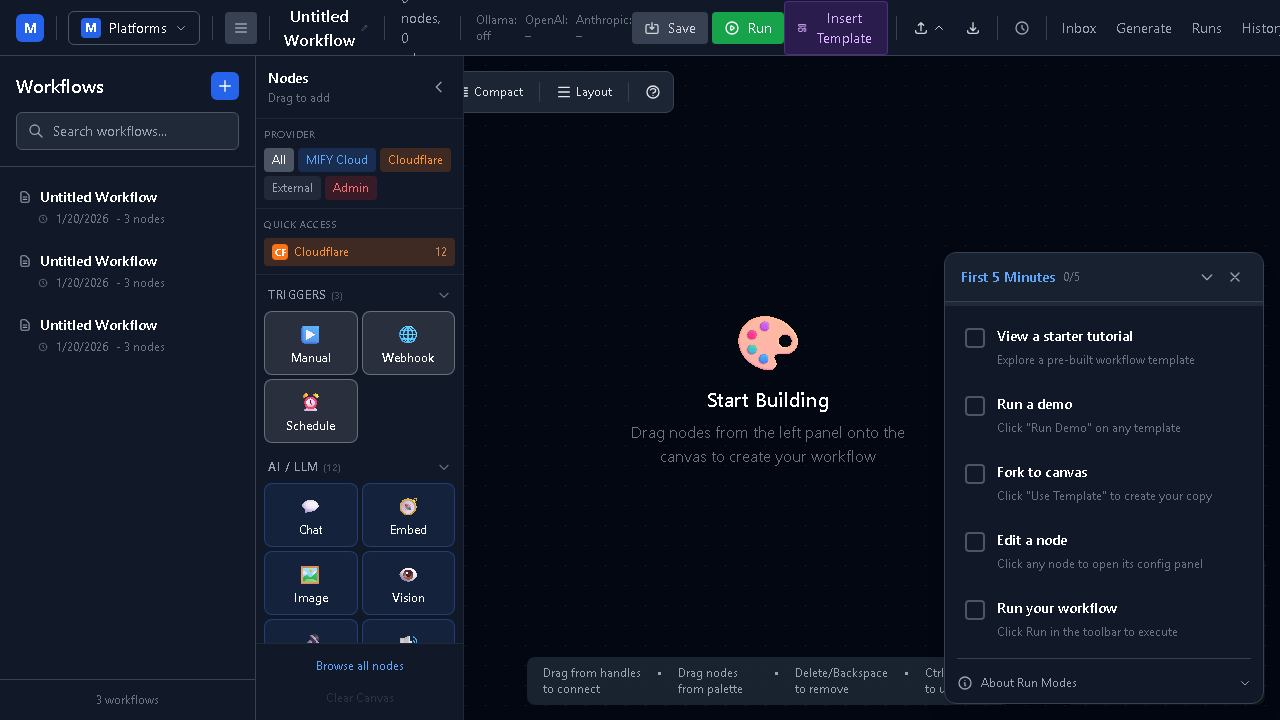
Section titled “Platform Overview”MIFY is a 47-package TypeScript monorepo: Hono API (171 production route files), Next.js 15 frontend (205 pages), PostgreSQL + pgvector, Redis, Prisma 6, and 126 native nodes across 24 categories.
Access
Section titled “Access”MIFY is not open-source at this time. Access is available through the hosted platform or by arrangement with the MIFY team.
What’s available now:
- Hosted platform — use MIFY at mify.com
- API access — REST endpoints for programmatic integration
- Plugin system — build and publish plugins without access to the core codebase
Coming later:
- The Home Client (local agent runtime) may be released as a public repository
- Additional open-source components may follow
API (171 route files)
Section titled “API (171 route files)”Full interactive reference: API Explorer | API Reference
Core Workflow API
Section titled “Core Workflow API”# CRUDPOST /api/graphs # Create workflowGET /api/graphs # List workflowsGET /api/graphs/{id} # Get workflowPUT /api/graphs/{id} # Update workflowDELETE /api/graphs/{id} # Delete workflow
# Import from external platformsPOST /api/graphs/import/flowisePOST /api/graphs/import/difyPOST /api/graphs/import/langflowPOST /api/graphs/import/n8n
# ExecutionPOST /api/graphs/{id}/run-templates/{tid}/executeGET /api/graphs/{id}/comparison-historyPOST /api/graphs/{id}/baselineContent Generation API
Section titled “Content Generation API”POST /api/content-gen/queue # Async GPU generation (ComfyUI)POST /api/content-gen/provider # Sync/streaming from AI providersPOST /api/content-gen/comfyui-local/finalize # Local ComfyUIGET /api/content-gen/runs # HistoryGET /api/content-gen/runs/{id} # Run detailExecution & Training API
Section titled “Execution & Training API”POST /api/execution/runs # Submit image/video/vision jobPOST /api/execution/training/submit # Submit training runPOST /api/execution/training/datasets/upload # Create datasetPOST /api/execution/training/datasets/{id}/presign-file # R2 upload URLGET /api/execution/training/models # Model registryKnowledge Base / RAG API
Section titled “Knowledge Base / RAG API”POST /api/knowledge-bases # Create KBPOST /api/knowledge-bases/{id}/ingest # Ingest documentsPOST /api/knowledge-bases/{id}/search # Semantic searchOther Key APIs
Section titled “Other Key APIs”| Area | Base Path | Endpoints |
|---|---|---|
| Templates | /api/templates | Browse, categories, enterprise |
| Evaluations | /api/evaluations | Datasets, runs, results |
| Chat | /api/chat | Sessions, messages |
| Tools | /api/tools | CRUD for agent tools |
| AI Builder | /api/ai-builder | Natural language → workflow |
| Prompt Lab | /api/prompt-lab | Prompt versioning, A/B compare |
| Vector Stores | /api/vector-stores | Store, query vectors |
| Batch | /api/batch | Batch job management |
| Triggers | /api/triggers | Webhook, schedule, event triggers |
| Packs | /api/packs | Provider pack management |
| ComfyUI | /api/comfyui | Workflow registry, job submission |
| Plugins | /api/plugins | Plugin ecosystem |
126 Native Nodes (24 Categories)
Section titled “126 Native Nodes (24 Categories)”| Category | Count | Key Nodes |
|---|---|---|
| Platform | 30 | Dify, Flowise, Langflow, n8n, ActivePieces, Node-RED, Composio static actions (Apollo, Zoom, Linear, Notion), 20+ more |
| LLM | 13 | Chat, Embed, Image, Vision, ASR, TTS, Translate, Classify |
| HITL | 12 | Pause, review gates, Home Client runtime nodes |
| I/O | 11 | HTTP, Cloudflare D1/KV/R2/Queue |
| RAG | 8 | Ingest, Chunk, Embed, Store, Retrieve, Rerank |
| Agent | 11 | ReAct, Multi-Agent (Plan-and-Execute, Reflection, Supervisor, Swarm), CLI Agent, EnvInspect, Browser Use, Computer Use |
| Control | 6 | Route If, Route Switch, Loop Map, Sub-Workflow |
| Safety | 3 | PII Detector, Injection Detector, Jailbreak Detector |
| Enterprise | 8 | Email, Calendar, Notifications, Messaging |
| Sandbox | 5 | sandbox.exec, sandbox.plan, sandbox.session, host.apply, workspace |
Substrate System (Sandbox Execution)
Section titled “Substrate System (Sandbox Execution)”Execute commands in isolated environments:
| Substrate | What It Does |
|---|---|
| RawHostSubstrate | Execute on host machine directly |
| CloudflareSandboxSubstrate | Execute in Cloudflare Workers Containers |
| SubstrateRouter | Routes requests to appropriate substrate |
New sandbox nodes: mify.sandbox.exec, mify.sandbox.plan, mify.host.apply, mify.workspace, mify.sandbox.session
Backend Capability Registry (Session-4)
Section titled “Backend Capability Registry (Session-4)”Each runtime backend (LLM, document parser, browser, sandbox) is fronted by a resolver that picks per-workspace credentials with org/global fallback. Resolvers expose a BackendCapabilityManifest that auto-generates admin + workspace UI pages.
| Capability | Workspace Setting | Admin Fallback |
|---|---|---|
| LLM | /workspaces/[id]/settings/llm | /admin/llm-fallback |
| Document Parser | /workspaces/[id]/settings/parser | /admin/parser-fallback |
| Browser | /workspaces/[id]/settings/browser | /admin/browser-fallback |
| Sandbox | /workspaces/[id]/settings/sandbox | /admin/sandbox-fallback |
API: /api/admin/{llm,parser,browser,sandbox}-fallback/* and /api/workspaces/:id/settings/{llm,parser,browser,sandbox}/*.
Graph Versioning (W16-1)
Section titled “Graph Versioning (W16-1)”Every published version of a workflow is captured in the GraphVersion table for rollback, diff, and audit.
# List versionsGET    /api/graphs/:id/versions
# Publish current draft as a new version (idempotent)POST   /api/graphs/:id/publish
# Archive the currently-published versionPOST   /api/graphs/:id/archive
# Fork a prior version into a new draft (resurrect/edit)POST   /api/graphs/:id/draft-from/:versionId
# Diff two versions (3-layer JSON diff with d-m-p text deltas)GET    /api/graphs/:id/versions/:vA/diff/:vB
UI at /graphs/[graphId]/versions — VersionPicker, VersionDiff (line-level via diff-match-patch), and LifecycleControls.
Durable Workflow Execution + Time-Travel (W16-10)
Section titled “Durable Workflow Execution + Time-Travel (W16-10)”Long-running graphs run on Temporal. Each node executes as a Temporal Activity, so the runtime survives process restarts, scales horizontally, and can be paused/resumed.
# Time-travel APIGET /api/temporal-time-travel/history/:runId # full event historyPOST /api/temporal-time-travel/replay # re-execute from a chosen stepPOST /api/temporal-time-travel/fork # fork into a new run with optional input overrideGET /api/temporal-time-travel/runs # list durable runs (filterable)UI: /admin/temporal/durable lists all durable runs; /workflows/[graphId]/runs/[runId] shows the full step-by-step trace with a “replay from here” affordance.
Each node receives account-bound credentials via resolveForNode inside Activities, so Activities never leak access tokens. Search-attributes are wired for fast queries by graphId, userId, and status.
Partial Execution (W16-9)
Section titled “Partial Execution (W16-9)”Re-run only the dirty nodes when a workflow changes — not the entire DAG.
- Pure-logic core in
@mify/core— diffs current graph vs the last published version, marks downstream-of-dirty nodes - Postgres-backed cache (
PartialExecutionCachemodel) — node outputs cached by content-hash - DirtyNodesIndicator UI on canvas visualizes which nodes will re-run
- OversizedOutputBadge flags nodes whose outputs exceed cache-row limits
POST /api/canvas-execute # incremental run from canvasPOST /api/canvas-execute/admin/cache-clear # purge cache (admin)Realtime Collaborative Canvas (W16-8)
Section titled “Realtime Collaborative Canvas (W16-8)”Multi-user canvas editing with Hocuspocus + Yjs.
@mify/collabpackage: Yjs schema + bidirectional Y.Doc ↔ MifyGraph conversion- Hocuspocus server with Postgres persistence (
GraphYjsStatemodel) and SuperTokens auth handshake useCollabCanvashook handles Hocuspocus provider + remote-update receive path- Presence cursors — live multi-user cursor tracking with name + color
- Y.Doc save-back to canonical MifyGraph keeps graph-versioning intact
Workflow as Public API (W16-3)
Section titled “Workflow as Public API (W16-3)”Each Published workflow exposes a stable HTTP endpoint with auto-generated OpenAPI.
POST /api/workflow-endpoints/:slug # invoke workflow by slug (per-API-key rate limit)GET /api/workflow-endpoints/:slug/openapi.json # auto-generated OpenAPI 3.1 specGET /api/workflow-endpoints/:slug/info # URL + sample curl + rate-limit policyUI: WorkflowEndpointInfo panel on /graphs/[graphId]/versions.
Workflow as MCP / A2A / Agent Protocol
Section titled “Workflow as MCP / A2A / Agent Protocol”Each Published workflow is automatically exposed across three agent protocols:
# MCP (W16-4) — any MCP client can list + call workflowsGET    /api/workflow-mcp/list_toolsPOST   /api/workflow-mcp/call_tool
# A2A v1.0 (W16-5 + W17-7/8)GET    /api/a2a-server/.well-known/agent-card    # AgentCard with auto-populated skillsPOST   /api/a2a-server/tasks/sendGET    /api/a2a-server/tasks/:id
# LangGraph Agent Protocol (W17-9 + W19-1)GET    /api/agent-protocol/agentsPOST   /api/agent-protocol/agents/:id/invokePOST   /api/agent-protocol/agents/:id/stream
All three live in @mify/agents-network. The OpenAI Agents SDK adapter node (W19-2) handles the outbound direction — call any OpenAI Assistant from a Mify graph.
Workflow Settings
Section titled “Workflow Settings”PUT /api/graphs/:id # metadata-merge with allowlist # (name, description, slug, scheduleHints, endpointAuth, tags, ...)UI at /graphs/[graphId]/settings with cross-link from the versions page.
Anonymous Demo Runner
Section titled “Anonymous Demo Runner”Public unauth runner for starter templates, with rate-limit + LLM router + global daily gauge.
POST /api/public-demo-run/start # start an anonymous runGET /api/public-demo-run/:runId/statusGET /api/public-demo-run/:runId/events # SSE event streamAnonymousLlmDailyUsage model enforces a hard daily token ceiling globally. Cleanup cron + boot gate prevent runaway costs. UI wrapper at /templates/starter/[slug].
AI Builder + Multi-Agent Strategies
Section titled “AI Builder + Multi-Agent Strategies”POST /api/ai-builder/generate # NL → workflow graph (W15-5)Multi-agent runtime supports 4 strategies:
- Plan-and-Execute — decompose goal → execute subtasks
- Reflection — generate-then-critique loop
- Supervisor — hierarchical coordinator + workers
- Swarm — peer-to-peer message bus
Forms System
Section titled “Forms System”Multi-page form builder + workflow trigger, fully wired:
POST /api/forms # create form (workspace-scoped)GET /api/forms/:id # render-time form definitionPOST /api/forms/:id/submit # submit → calls FormTriggerPlugin → triggers workflowUI: /forms (list), /forms/[formId] (render), /forms/[formId]/builder (drag-drop multi-page builder with conditional fields). Persistence via the MifyForm Prisma model. The FormTriggerPlugin (packages/triggers/src/plugins/FormTriggerPlugin.ts) handles the trigger side.
Chat Widget (Demo 0)
Section titled “Chat Widget (Demo 0)”Public unauth chat widget for franchise sites:
POST /api/chat-widget/message # Public unauth Demo 0 endpointHardened with rate-limit, quota guard, redaction (W15-14). Powers /embed/chat.
Graph Schedules
Section titled “Graph Schedules”Cron-based graph execution stored in PostgreSQL:
# Create schedule from templatePOST /api/home/schedules/from-template
# Check if execution is waiting for HITL approvalGET /api/home/schedules/:id/waiting
# Approve paused executionPOST /api/home/schedules/:id/approve
# Execution historyGET /api/home/schedules/:id/executions
Supports webhook notifications for schedule events.
Plugin System
Section titled “Plugin System”Build, test, and publish plugins:
npx mify-plugin init my-pluginnpx mify-plugin dev # Hot reload dev servernpx mify-plugin test # Run testsnpx mify-plugin validate # Check manifestnpx mify-plugin publish # Publish to marketplacePlugin manifest v1.4.0 — extend with custom nodes, adapters, and credentials. Sandboxed execution in V8 or WASM runtimes.
Plugin guide: Plugin Development
Hub & Integrations
Section titled “Hub & Integrations”Integration Hub (/integrations)
Section titled “Integration Hub (/integrations)”Central discovery page for 28+ platform integrations. Platform registry with health monitoring, quick-connect flows.
Platform Adapters
Section titled “Platform Adapters”- Track A (native): Dify, Flowise, Langflow, n8n, OpenClaw, RAGFlow, DocuSeal
- Track B (registry-driven): 28+ self-hosted and SaaS platforms
OAuth Integrations
Section titled “OAuth Integrations”- Gmail, Outlook (email)
- Google Calendar, Outlook Calendar
- Composio connector marketplace
Platform Package (@mify/platform)
Section titled “Platform Package (@mify/platform)”8 service interfaces: Identity, Payments, Ledger, Jobs, AIExecution, Media, Events, Notifications. Studio-backed adapters with JWT auth.
Home Runtime (Local Agent Execution)
Section titled “Home Runtime (Local Agent Execution)”Run AI coding agents locally:
- CAO multi-agent backend — coordinate Claude Code + Codex with human review
- 9-state FSM — INIT → Agent1 → Diff → Agent2 Review → Human Gate → Done
- Cron scheduler — scheduled agent runs with timezone support
- LiteLLM client — model selection and provider-aware scheduling
- Prompt templates — structured prompt assembly with provenance tracking
WebSocket bridge on port 3020. API: /api/home/schedules, /api/home/sync.
Guide: Home Client
Execution Engine
Section titled “Execution Engine”Three execution classes:
- Deterministic — same input = same output (Template, JavaScript nodes)
- Probabilistic — AI nodes where output varies (Chat, Embed)
- Opaque — external platform calls (Dify, Flowise)
Trust levels: Trusted → Semi-Trusted → Opaque. Rigor modes: Experimental (fast) vs Audited (full trail).
Batch processing with concurrency control, pause/resume/cancel.
Guide: Execution & Trust
Content Generation Pipeline
Section titled “Content Generation Pipeline”Three paths:
| Path | How | Best For |
|---|---|---|
| MIFY Queue | ComfyUI workflows → GPU providers (Novita, Vast) | High-quality image/video |
| AI Provider | Direct AI calls, sync or SSE streaming | Text, quick images |
| ComfyUI Local | Local GPU | Custom models |
WorkflowDefinition model with 12 override types, 11 UI widgets for dynamic forms. Redis-based rate limiter, Prometheus metrics, cost tracking.
Guide: Content Generation
AI Providers (140+ via LiteLLM, 16 native)
Section titled “AI Providers (140+ via LiteLLM, 16 native)”16 native: OpenAI, Anthropic, Google Gemini, Groq, Mistral, Cohere, xAI, DeepSeek, Together AI, Fireworks, Hugging Face, OpenRouter, SambaNova, GitHub Models, Cloudflare Workers AI, Ollama.
140+ providers / 2,600+ models / 35 unique endpoints via LiteLLM — live count at models.litellm.ai/providers. Admin at /admin/litellm.
Provider packs (Fast/Balanced/Accurate), BYOK credential management, cost estimation.
Guide: AI Provider System
Cloudflare Native Nodes (12)
Section titled “Cloudflare Native Nodes (12)”- D1: Query
- KV: Get, Put, List, Delete
- R2: Get, Put, List, Delete
- Vectorize: Query, Upsert
- Queues: Send
Marketplace API
Section titled “Marketplace API”# Expert servicesGET /api/experts # Browse expertsPOST /api/jobs # Post a jobPOST /api/bids # Submit a proposal
# SolutionsGET /api/solutions # Browse solutionsPOST /api/purchases # Purchase a solution
# PaymentsPOST /api/escrow # Escrow operationsGET /api/payouts # Payout managementDatabase
Section titled “Database”Main DB: PostgreSQL with Prisma 6 (173 models). Franchise DB: separate bounded-context database (10 models).
Testing
Section titled “Testing”1200+ E2E tests across 157 Playwright spec files. Vitest for unit tests.
pnpm test # All unit testspnpm test:e2e # Full E2E suitepnpm test:e2e:smoke # Fast smoke testsKey Resources
Section titled “Key Resources”| Resource | Link |
|---|---|
| Interactive API Explorer | /api-explorer/ |
| API Reference | /reference/api-reference/ |
| Building Workflows | /guides/workflows/ |
| Plugin Development | /guides/plugins/ |
| Platform Connections | /guides/connections/ |
| Content Generation | /guides/content-generation/ |
| Home Client | /guides/home-client/ |
| Glossary | /reference/glossary/ |